
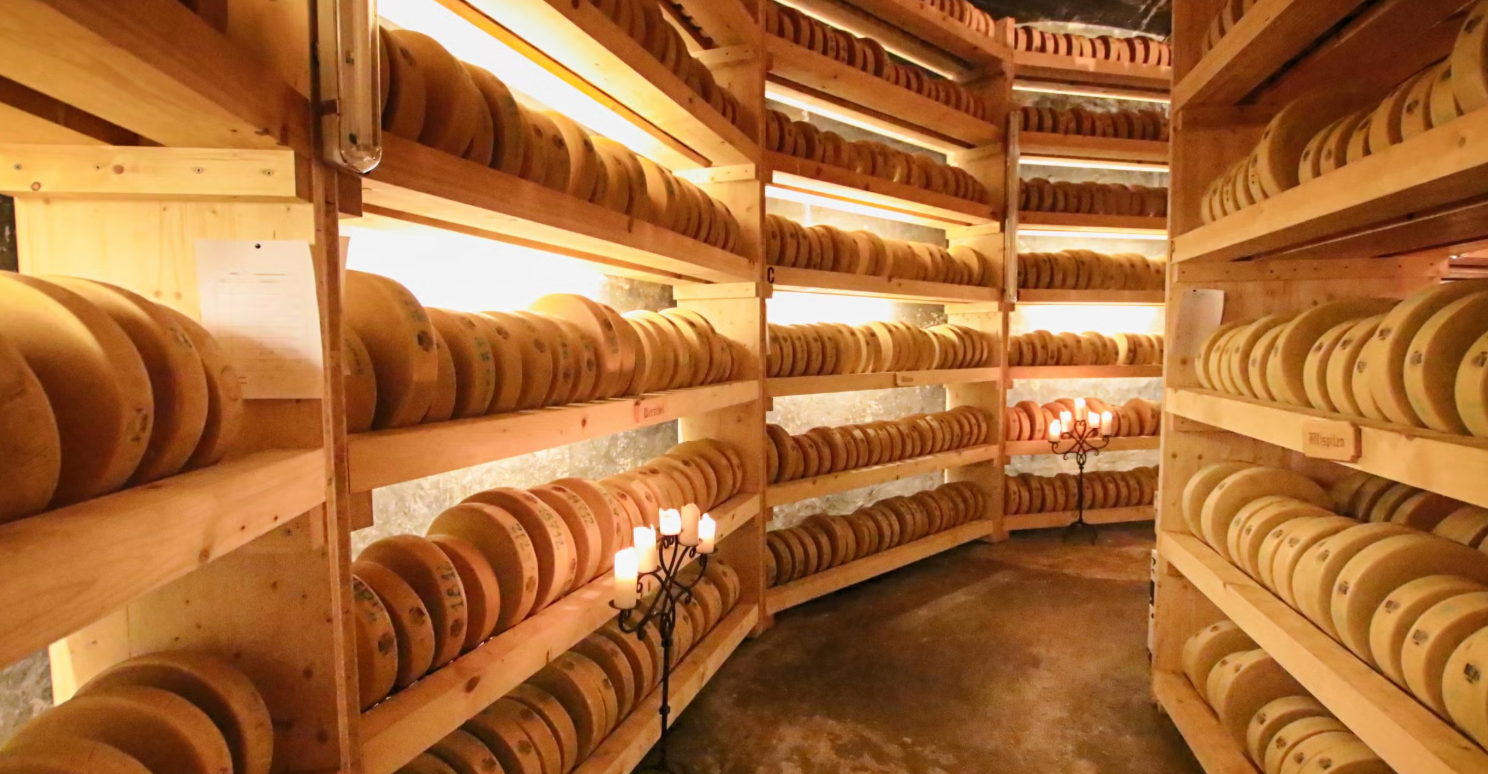
Six hundred and fifty feet beneath Giswil Mountain in central Switzerland, in tunnels that once stored ammunition, spare parts for fighter jets, and guided missiles, 90,000 wheels of raclette cheese are slowly ripening in the dark.
The temperature holds steady at 11°C. The humidity never varies. No vibration reaches the cheese from the surface.
No sunlight, no wind, no seasonal fluctuation — just two 100-metre-long tunnels of constant, perfect conditions that the Swiss military spent a fortune engineering for the storage of explosives, and that a cheesemaker named Seiler Käserei AG now uses for an entirely different kind of controlled detonation: the slow biochemical transformation of milk into one of Switzerland’s most prized foods.
It is, by any measure, one of the stranger second acts in the history of military infrastructure.
Why bunkers make perfect cheese caves
The logic is surprisingly elegant. Cheese affinage — the art of aging cheese to develop its flavour, texture, and character — requires precisely the conditions that military bunkers were engineered to provide.
Artisan cheese needs a stable temperature between 10°C and 15°C, consistent humidity around 90–95%, minimal vibration, protection from light and UV, and good air circulation. Traditional cheese caves — natural limestone caverns or purpose-built underground cellars — achieve this through geology. Swiss military bunkers achieve it through reinforced concrete walls, ventilation systems designed for months of sealed occupation, and the thermal mass of the mountain itself.
The military spent enormous sums perfecting these environments. Temperature regulation, air filtration, humidity control, blast-proof construction — all designed to keep soldiers alive and munitions stable for extended periods underground. When the soldiers left and the munitions were removed, what remained was, essentially, an industrial-grade climate-controlled cave. A cheese affineur’s dream.
The economics sealed the deal. Building a purpose-built affinage facility of comparable size and environmental quality from scratch would cost millions. Buying a decommissioned military bunker cost a fraction of that. The concrete was already poured. The ventilation was already installed. The mountain was already doing the insulation work for free.
Seiler Käserei AG: 90,000 wheels beneath a mountain
The most famous bunker cheese operation in Switzerland is Seiler Käserei AG in Giswil, in the canton of Obwalden. The company acquired a former military fortress called Pfedli — burrowed into the dolomite, flysch, and chalk of Giswil Mountain — and converted its ammunition storage tunnels into ripening rooms for their raclette cheese.
The fortress sits more than 200 metres beneath the surface. During its military life, Pfedli stored ammunition, spare parts for fighter jets, and guided missiles. The tunnels were engineered to withstand direct bombardment, with reinforced concrete walls thick enough to absorb the blast energy of a nearby nuclear detonation. Ventilation systems maintained constant air quality.
Temperature regulation was built into the design — the thermal mass of the surrounding rock, combined with the bunker’s depth, creates an environment that barely fluctuates regardless of what happens on the surface.
When Seiler took over the facility, the conversion was relatively straightforward. The ammunition racks came out. The cheese racks went in. The ventilation systems that had kept soldiers breathing now keep the cheese at optimal humidity.
The blast-proof structure that was meant to survive a war now protects raclette from the one thing that could ruin it: inconsistency.
The scale is remarkable. At any given time, 90,000 wheels of raclette sit in storage racks that line the two main tunnels, each 100 metres long.
The wheels are turned and tended by staff who commute daily into the mountain, working in conditions that haven’t changed since the military occupied the same corridors — except that the air now smells of aging cheese rather than gun oil.
Each wheel needs regular attention during its months of aging: turning, brushing, monitoring. The staff work methodically through the rows, wheel by wheel, tunnel by tunnel, in conditions of near-total silence.
The bunker’s construction provides the thermal stability that raclette requires. The cheese develops its characteristic meltability, nutty flavour, and smooth texture in an environment that never wavers by more than a degree. No mechanical refrigeration is needed.
No energy is spent on climate control. The mountain does the work, just as it was designed to — for a purpose its builders could never have anticipated.
While the aging tunnels themselves are not open to the public (food safety regulations prevent visitor access to active production areas), Seiler operates a cheese shop at the entrance to the bunker complex where visitors can taste and purchase the products that matured inside the mountain.
The raclette is excellent — and knowing that it ripened in a former missile store adds a dimension that no marketing department could invent.
Gourmino: Gruyère in a fortress
Seiler isn’t the only company that spotted the opportunity. Gourmino, a Swiss cheese affinage specialist, took the concept further by acquiring a larger decommissioned military cave and transforming it into a full-scale professional aging facility.
The project began when Gourmino’s managing director, Roland Sahli, realised that the company needed significantly more affinage capacity but couldn’t justify the cost of building from scratch. A new facility of comparable size and environmental quality would have run into the millions.
A decommissioned military fortress — with its thick concrete walls, engineered ventilation, and mountain-insulated thermal stability — offered the same performance at a fraction of the price. “The military spent a lot of money making every detail perfect,” noted Gourmino’s marketing director, Karina Jeker.
After two years of planning and one year of construction, the company opened its bunker facility. The conversion was more ambitious than Seiler’s. To ease the flow of cheese, equipment, and workers between the four separate bunker tunnels, construction workers blasted an entirely new transverse tunnel into the rock — connecting chambers that the military had deliberately kept isolated.
A local carpenter, Hansueli Ryter, was commissioned to construct 30,000 red spruce boards for the aging racks. The job was so large that Ryter’s workshop in the village had to be physically expanded to accommodate the production.
The result is a professional affinage operation of extraordinary scale. The first tunnel is filled with Gruyère AOP, Sbrinz, and other alpine wheels — each one turned and tended by hand during its aging period. The second holds 4,400 wheels of Emmentaler AOP and Rahmtaler, a full-fat variation that develops its character over months of patient ripening.
The remaining two tunnels are rented to other cheese producers, creating a small ecosystem of affinage inside what was once a sealed military installation.
The cheeses age for between 10 and 24 months. During that time, they undergo the slow biochemical changes — the breakdown of proteins, the development of crystals, the intensification of flavour — that transform fresh cheese into something far more complex. The bunker provides an environment so stable that the process can unfold with almost laboratory-level consistency, batch after batch, year after year.
The broader trend: bunkers feeding Switzerland
Cheese is the headline, but it’s not the only food being produced inside Swiss military infrastructure. A quiet agricultural revolution is underway in the country’s decommissioned bunkers, driven by the same basic insight: the military built perfect growing and storage environments, and now that the military is done with them, farmers and food producers are moving in.
In Erstfeld, near the Gotthard, the company Gotthard-Pilze operates eleven former ammunition bunkers as a mushroom farm. The conditions underground — consistent temperature, high humidity, total darkness — are ideal for growing shiitake, oyster mushrooms, and other speciality varieties that require precisely the environment that an ammunition store was designed to maintain.
The operation produces approximately 24 tonnes of organic shiitake mushrooms per year from tunnels that once stored explosives. Workers tend the growing racks in the same corridors where soldiers once inventoried munitions.
In Stansstad, near Lake Lucerne, a similar operation uses former bunkers for mushroom cultivation. And across the country, decommissioned positions have been repurposed as wine cellars, exploiting the same thermal stability that benefits cheese aging. The constant temperature eliminates the need for expensive climate control systems, and the protection from light and vibration means wines can age undisturbed for years in conditions that few purpose-built cellars could match.
The pattern is consistent: Swiss military engineers spent decades and billions of francs creating perfect underground environments for storing things that needed to be kept at constant temperature, protected from shock, and sealed from the outside world. It turns out that the requirements for storing munitions and the requirements for storing food have a surprising amount in common. Both need stability. Both need consistency. Both suffer from fluctuation. The only difference is the payload.
A Swiss story
There’s something distinctly Swiss about the whole enterprise. A country that fortified itself against invasion for 140 years, built 20,000 military installations inside its own mountains, and then — when the threat receded — turned the guns into cheese racks, the ammunition stores into mushroom farms, and the barracks into hotel rooms. No waste. No sentiment. Just a pragmatic national pivot from one kind of valuable commodity to another.
The conversion wasn’t inevitable. In many countries, decommissioned military sites simply decay — locked up, fenced off, slowly returning to nature or crumbling into disrepair. Switzerland’s approach has been characteristically different. The government sold the bunkers. Entrepreneurs bought them. And within a few years, spaces that had been designed to sustain soldiers during a nuclear winter were sustaining raclette, Gruyère, shiitake mushrooms, and award-winning wines instead.
The cultural resonance runs deeper than simple pragmatism, though. In Switzerland, the bunker is not just a military artefact — it’s a civic one. Every Swiss citizen has a place in a shelter. Every new building was required to include one until recently. The bunker is woven into the everyday fabric of Swiss life in a way that has no parallel elsewhere. So when a bunker stops serving one purpose, it’s natural — perhaps even expected — that it should start serving another.
The bunkers at Giswil stored missiles designed to destroy. They now store raclette designed to melt over potatoes at dinner tables across the country. The tunnels at Erstfeld held explosives that could collapse bridges. They now grow mushrooms that end up in Zurich restaurants. The Gourmino caves hold Gruyère wheels that will eventually grace cheese boards from Geneva to Tokyo. The irony is not lost on anyone, but it’s also not the point. The point is that these spaces are too good — too precisely engineered, too perfectly situated, too expensively built — to leave empty.
Switzerland’s cheesemakers figured that out before almost anyone else. And now, 650 feet beneath a mountain in Giswil, 90,000 wheels of raclette are proving them right — one slow, silent day at a time.
Related bunker profiles: Sasso San Gottardo · La Claustra
Related articles: The National Redoubt: How Switzerland Turned the Alps Into a Weapon
Know of a bunker being used for food production that we haven’t covered? Contact info@bunkersofswitzerland.com.