
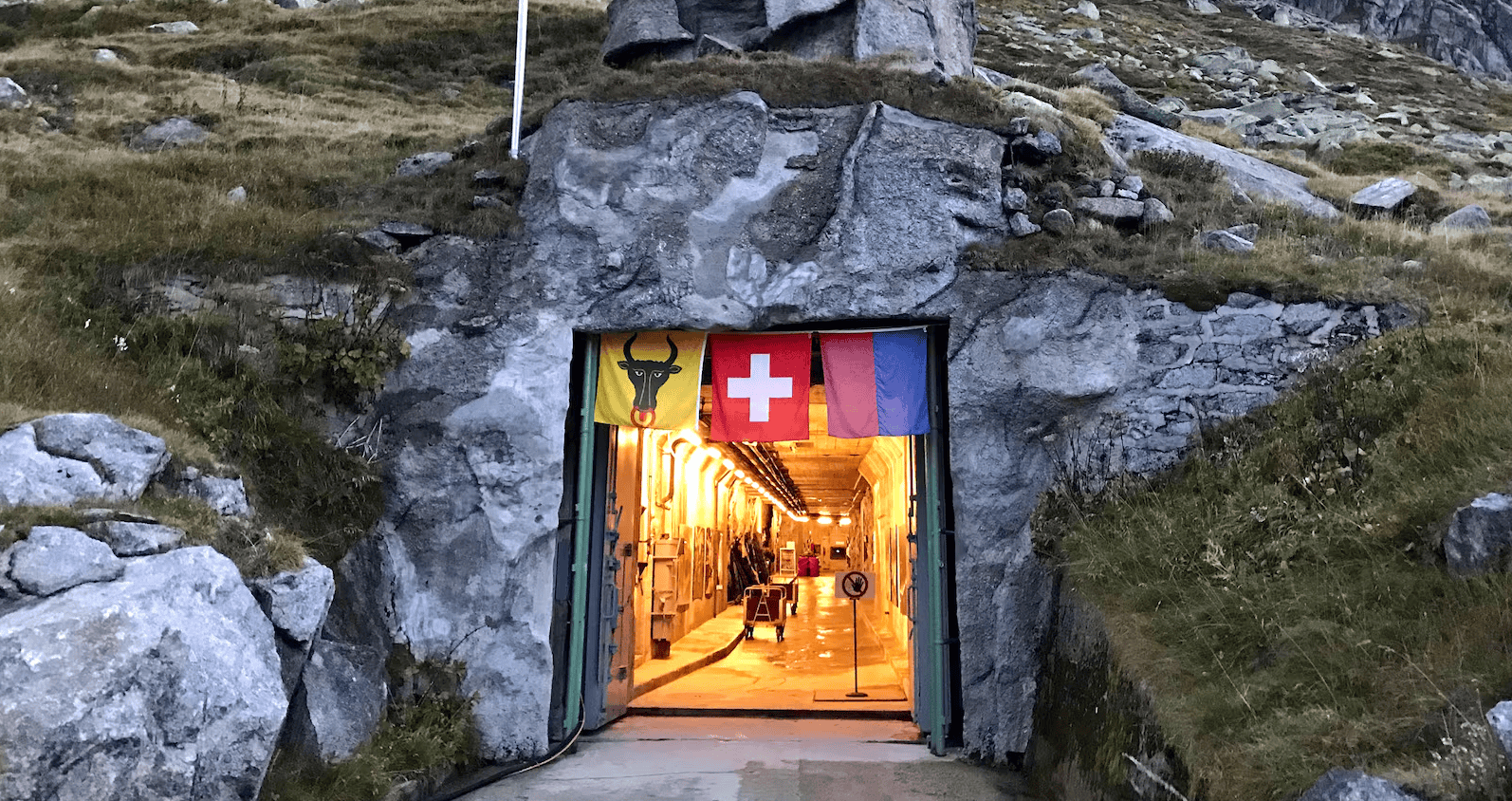
Somewhere beneath the picture-postcard surface of Switzerland — the fondue, the cowbells, the precision railways — there are 20,000 military installations carved into the mountains. Most are sealed. Many are classified. But a growing number have opened their blast doors to the public, offering visitors a chance to walk through tunnels that were state secrets within living memory.
This is a complete guide to every publicly accessible bunker museum in Switzerland: what to expect inside, how to get there, what it costs, and how to plan a trip that connects multiple sites into a single unforgettable journey through the country’s hidden military history.
Before You Go: Essential Practical Advice
Every bunker museum in Switzerland shares a few characteristics that are worth knowing before you plan your visit.
Temperature: Underground temperatures in Swiss bunkers sit between 8°C and 12°C year-round, regardless of the weather outside. Bring a warm layer even in July. Several museums provide military trench coats from the 1970s for visitors to wear during the tour — atmospheric, but bring your own jacket to be safe.
Footwear: Tunnel floors are concrete or bare rock, often damp. Wear closed, grippy shoes. Heels and sandals are a bad idea in a mountain fortress.
Booking: Most bunker museums have severely limited opening hours — often only weekends, sometimes only one Saturday per month, and frequently by appointment only. Alpine sites like Sasso San Gottardo are only accessible from June to October when the mountain passes open. Always check schedules and book ahead. Showing up unannounced at a sealed blast door on a Tuesday is a very Swiss way to waste a day.
Accessibility: These are military installations built inside mountains. Narrow tunnels, steep stairs, and low ceilings are standard. Most are not wheelchair accessible, and some are not suitable for visitors with claustrophobia. Individual museum listings below note accessibility where known.
Swiss Travel Pass: If visiting multiple sites across regions, the Swiss Travel Pass covers all trains, buses, and lake boats. Several bunker museums offer discounts for pass holders.
The Major Museums
Sasso San Gottardo — Gotthard Pass, Ticino
The flagship. Sasso San Gottardo is the largest fortress complex open to the public in Switzerland, built between 1941 and 1945 inside the Gotthard massif — the geographic and symbolic heart of the Swiss Alps. It was declassified in 2001 after someone attempted to break into it, forcing the government’s hand.
The experience begins before you even enter. The approach to the Gotthard Pass — whether via the serpentine old Tremola cobblestone road from Airolo or the route from Andermatt — is itself a journey through the landscape that made the National Redoubt possible. You arrive at over 2,000 metres altitude in a lunar landscape of rock and thin air.
Inside, hundreds of metres of tunnels lead to the Metro del Sasso, an underground funicular excavated through the mountain that carries visitors to the fortress itself. Cold, damp air cuts through the carriage as it climbs in near darkness. At the top, instead of an alpine view, you emerge in a military command centre frozen in time. Spartan barracks with wooden bunk beds dressed in stiff khaki sheets. Strategy maps still hanging on the walls of the fire direction centre. Ammunition depots. And two artillery positions — 15 cm guns that could fire 17 kilometres — with a panoramic terrace carved into the mountainside that offers views of the serpentine roads skirting snow-veined peaks.
The fortress also houses permanent exhibitions on alpine crystals (including some of the largest groups ever found in the Alps, displayed in a darkened gallery where quartz crystals the size of small trees shimmer under spotlights), a Goethe exhibition documenting the poet’s three pilgrimages to the Gotthard, and installations on renewable energy. Italian artist Tullio Zanovello’s enormous seven-door installation — 7 metres long, 4.5 metres high, 1.5 tonnes — presents a 20-minute immersive experience of Gotthard myths and legends with choral music composed by the artist himself.
Key details:
- Season: June to October (pass must be open)
- Duration: 2 hours (individual visit) or 4 hours (guided “Custodian of the Fortress” tour — strenuous, through tunnels, caverns, and manholes, includes army emergency rations)
- Price: CHF 20 (exhibitions only) / CHF 25 (fortress + exhibitions) — free for under-16s and Swiss Museum Pass holders
- Getting there: Gotthard Pass road from Airolo (south) or Andermatt (north). The old cobblestone Tremola road from Airolo is spectacular but slow — allow extra time
- Contact: info@sasso-sangottardo.ch / +41 844 11 66 00
- Tip: Combine with a stop at the Caseificio del Gottardo (Gotthard Dairy) in Airolo for regional cheese. If you have a full day, drive the pass in both directions — the north and south approaches offer completely different landscapes
Sonnenberg Bunker — Lucerne
The world’s largest civilian nuclear fallout shelter, built between 1970 and 1976 beneath the A2 motorway right in the centre of Lucerne. If it had ever been activated, four 350-ton blast doors would have sealed two motorway tunnels, creating shelter for 20,000 people — one-third of Lucerne’s population — in a seven-storey underground complex.
The scale of what was planned is staggering. The logistics centre stored 450 tons of flat-packed bunk beds and portable toilets. The medical wing contained a hospital with 336 beds, two operating theatres, and its own laundry. There was a command post with a meeting room, a radio studio, a power supply system, an air filtration plant, a police station, and detention cells. The entire complex was designed to be self-sufficient — a city beneath a city, sealed from the outside world by blast doors that could withstand a nuclear shockwave.
There was one critical problem: setting up all those bunk beds and toilets would have taken up to two weeks. In the age of intercontinental ballistic missiles, there wouldn’t have been anywhere near that much warning time. The 1987 test exercise, Operation Ant, confirmed the worst — the doors couldn’t be closed, communications failed, and only a quarter of the planned setup was completed in a week. The bunker was never fully tested again.
Since 2008, the Sonnenberg has been open for guided tours. The guides — knowledgeable, wry, and clearly personally invested in the history — take visitors through the command centre, medical facilities, air filtration systems, and the logistics areas that would have sustained this underground population. They explain not just the engineering but the human dimension: what it would have meant to live underground with 20,000 strangers while the world above burned. Visitors frequently describe it as one of the most thought-provoking experiences in Lucerne, a city better known for Chapel Bridge and chocolate shops.
Key details:
- Season: April to September (public tours); private tours by arrangement year-round
- Duration: 2 hours
- Price: CHF 30 per person (cash only on site)
- Booking: English tours run on the last Sunday of the month at 11:00 — book in advance via email (englishtours@unterirdisch-ueberleben.ch), stating the date and number of people. Private tours for groups can be arranged at other times but cost more
- Meeting point: Jesuitenplatz, Lucerne, in front of the Jesuit Church (not at the bunker itself — you walk there together)
- Accessibility: Seven storeys connected by stairs and narrow corridors. There are lifts but they are not available for tourist use. Not suitable for visitors with limited mobility
- Tip: Tours fill up weeks in advance in summer. Book as early as possible. The meeting point in front of the Jesuit Church is in the heart of Lucerne’s old town — arrive early and enjoy the surroundings
Festung Fürigen — Stansstad, Lake Lucerne
A Cold War artillery fortress bored into the mountain on the shores of Lake Lucerne, in the canton of Nidwalden. What looks like an old shed from the outside opens into a 200-metre tunnel system leading to gun positions, living quarters, a communications room, and ammunition stores that were part of an intricate network of more than ten fortresses protecting central Switzerland.
The experience is deliberately atmospheric: poorly lit incandescent lamps, seeping walls, and the clammy 10–12°C air transport visitors into what life was like for the soldiers who manned these positions during the Cold War. Old military trench coats from the 1970s are offered to visitors on arrival. In central Switzerland alone, the surrounding fortress network housed 44 cannons across nine installations of various sizes.
Key details:
- Season: April to October (limited opening days)
- Duration: 1–1.5 hours
- Price: Check current pricing at festungfuerigen.ch
- Getting there: Stansstad is accessible by boat from Lucerne (a beautiful Lake Lucerne cruise) or by rail/bus
- Tip: Combine with the Sonnenberg tour for a Lucerne-region bunker day
Fort Reuenthal & Swiss Military Museum — Full-Reuenthal, Aargau
A two-site complex near the Swiss-German border comprising the original 1937–1939 artillery fortress and a separate exhibition hall housing one of the largest tank collections in Europe.
Fort Reuenthal itself is the real draw for bunker enthusiasts. Built to guard the Rhine crossing at the Dogern hydroelectric dam, it is fully equipped with its original 7.5 cm guns, medical wing, command rooms, kitchen, and accommodation. The fortress was designed for 90 soldiers but was occupied by around 150 during active service from 1939 to 1945. It was transferred to civilian use in 1979 and painstakingly restored to original condition by a museum association.
The separate Swiss Military Museum in Full displays tanks, artillery, anti-aircraft weapons, and vehicles covering 10,000 square metres of exhibition space. Highlights include the Oerlikon-Bührle AG factory collection and a King Tiger tank being restored to running condition.
Key details:
- Season: April to October
- Fortress: Saturdays only, 13:00–17:00
- Museum: Friday to Sunday, 10:00–17:00
- Price: CHF 15 (museum only) / CHF 22 (combo ticket for both)
- Getting there: Full-Reuenthal is in canton Aargau, near Bad Zurzach. Accessible by rail and short bus connection
- Tip: The museum runs “Bunker Safari” events and an annual Panzerweekend with live tank demonstrations — check their site for dates
Faulensee Artillery Fortification — Faulensee, Bernese Oberland
A camouflaged WWII artillery position built in just six months in 1942, with four 10.5 cm guns overlooking the Bernese Oberland from a position that blends invisibly into the hillside above the town of Faulensee. The fortress served as a secret base through the Cold War until decommissioning in 1993, and opened to the public in 2001.
Tours are led by expert guides in small groups, covering the gun positions, ammunition stores, connecting tunnels, and a recreated barricade in the target area that demonstrates how the fortifications would have stopped an advancing enemy. The tour concludes in the bunker’s own bistro.
Key details:
- Season: Limited opening days — check spiez.com for current schedule
- Duration: Approximately 1.5 hours
- Getting there: Near Spiez on Lake Thun, accessible by rail
- Tip: Spiez and the surrounding Bernese Oberland are beautiful in their own right — this bunker works well as part of a broader Lake Thun trip
Fort Heldsberg — St. Margrethen, St. Gallen
Part of the Fortress Sargans complex defending Switzerland’s eastern border, Fort Heldsberg is one of the most famous “Falsche Chalets” — military bunkers disguised as civilian buildings. Located near Lake Constance and the Austrian border, the fortress was built between 1938 and 1940 and remained in military use until 1992. Its exterior features painted-on windows and false shutters that conceal artillery positions within.
Since 1993, it has been open as a museum documenting the camouflage programme, the Rhine border defences, and the daily life of the garrison that manned the position.
Key details:
- Season: April to October (check current schedule)
- Getting there: St. Margrethen, near the Austrian border, is well-connected by rail
- Tip: Fort Heldsberg pairs naturally with Fort Magletsch and other Sargans-complex positions for an eastern Switzerland bunker itinerary
Fortress Saint-Maurice — Valais
The westernmost of the three great National Redoubt fortress complexes, Saint-Maurice controlled the Rhône valley with artillery positions capable of dominating the landscape from Lake Geneva to the Great Saint Bernard Pass. The fortress is not a single installation but a sprawling network of mutually supporting positions carved into the mountains on both sides of the Rhône valley, the principal fortification being the enormous Fort de Dailly.
Fort de Chillon, directly opposite the famous medieval castle, now offers an immersive visitor experience with augmented and virtual reality elements alongside the original fortifications. The contrast between the tourist-thronged medieval castle on one side of the water and the hidden 20th-century military fortress opposite it — one visible for centuries, the other secret until recently — is one of the most striking juxtapositions in Swiss tourism.
Key details:
- Season: Varies by individual fort — check forteresse-saint-maurice.ch
- Getting there: Saint-Maurice is on the main rail line between Lausanne and the Valais, well-connected and easy to reach
- Tip: Visit Fort de Chillon in the morning, the medieval Château de Chillon in the afternoon — a thousand years of defensive engineering in a single day
Festung Vitznau — Vitznau, Lake Lucerne
A lesser-known but rewarding addition to the Lake Lucerne bunker circuit. This private museum, housed in a WWII-era military bunker, documents the construction and operation of the fortifications that ring the lake. It is smaller and more intimate than Festung Fürigen, and its volunteer-run character gives it an authenticity that larger museums sometimes lack.
Key details:
- Season: Limited opening days — check in advance
- Getting there: Vitznau is on the Lake Lucerne boat route and is also the base station for the Rigi mountain railway — making it easy to combine with a day that includes both bunker history and one of Switzerland’s most famous alpine panoramas
- Tip: The boat from Lucerne to Vitznau is one of the most scenic lake cruises in Switzerland
Other Notable Sites
Several smaller bunker sites and fortress positions are accessible by appointment or during special open days, though they lack the established museum infrastructure of the sites listed above. These include Fort Furggels (Fortress Sargans), Fort Magletsch (Fortress Sargans, which remained in active military use into the 21st century), and the Crestawald fortifications in Graubünden. The Swiss Fortress Association (Schweizerische Gesellschaft für Befestigungsanlagen) maintains a list of members and open days at festungsverein.ch.
Planning Your Trip: Regional Groupings
The museums cluster into natural geographic groups that can be visited together. Here are the recommended combinations:
Lucerne Region (1–2 days): Sonnenberg + Festung Fürigen + Festung Vitznau. All three are accessible from central Lucerne, with Fürigen and Vitznau reachable by Lake Lucerne boat. This is the easiest bunker circuit in Switzerland — three very different sites (civilian shelter, military fortress, private museum) connected by one of the world’s most beautiful lake cruises. Stay in Lucerne and treat it as a bunker-themed weekend.
Gotthard Region (1–2 days): Sasso San Gottardo + La Claustra hotel (for an overnight stay inside a bunker). Only accessible June–October when the pass road is open. The Gotthard Dairy in Airolo is a natural lunch stop. If you have time, the nearby Fuchsegg fortress on the Furka Pass — a camouflaged artillery position disguised as a stable — is worth a detour, though it’s not a formal museum.
Eastern Switzerland (1 day): Fort Heldsberg + Fort Magletsch + other Sargans-complex sites. Rail-accessible from Zurich. This is the best circuit for understanding the eastern border defences and the camouflage programme.
Northern Border (1 day): Fort Reuenthal + Swiss Military Museum. A full day for military history enthusiasts. The combo ticket is good value, and the museum’s tank collection is one of the largest in Europe. Near the German border, easy to combine with a Rhine-region trip.
Western Alps (1 day): Fortress Saint-Maurice sites, including Fort de Chillon. Combine with a visit to Château de Chillon for the medieval-versus-modern contrast. Wine country in the surrounding Valais makes this region worth lingering in.
Bernese Oberland (half day): Faulensee artillery fortification. Works as a side trip from Interlaken or Spiez, both of which are worth visiting in their own right. Lake Thun is spectacular.
For the most ambitious itinerary, the build plan for this site includes a dedicated 3-day Gotthard Bunker Trail that connects the highest concentration of visitable fortresses in Switzerland — we will publish that guide separately.
Swiss Museum Pass
The Swiss Museum Pass (CHF 166 for one year) grants free entry to over 500 museums across Switzerland, including Sasso San Gottardo and several other bunker museums. If you are visiting three or more museums during your trip, it pays for itself quickly. Check which specific bunker museums are included at museumspass.ch.
What to Expect Inside
Every bunker museum is different in scale and focus, but certain elements recur. Expect narrow tunnels connecting larger chambers. Expect bare concrete and exposed rock. Expect poor natural lighting (deliberately preserved for atmosphere in most museums). Expect temperatures around 10°C and humidity that makes the air feel colder. And expect to come away with a profoundly different understanding of what Swiss neutrality actually cost to maintain.
The smaller sites — Faulensee, Fort Heldsberg — can be visited in under two hours. The major complexes — Sasso San Gottardo, Sonnenberg, Fort Reuenthal — reward a half-day commitment. And for anyone truly fascinated by this subject, an extended trip connecting multiple sites across regions reveals the sheer scale of what Switzerland built: not a few isolated bunkers, but an entire country turned into a fortress, hidden inside its own mountains.
The blast doors are open. The tunnels are lit. And 80 years of secrets are waiting.
Related bunker profiles: Sasso San Gottardo · Sonnenberg · Fort Heldsberg · Fortress Sargans · La Claustra
Planning a visit? For corrections, updated opening hours, or bunker museums we’ve missed, contact info@bunkersofswitzerland.com.